Royal Enfield Classic 650 First Ride Review
I used to use my friend’s Classic 350 to travel to college and run errands. People were staring at me like it was no big deal when I found rides on the Enfield. Unlike any other bike at the time, the chrome-draped tank with the classic style exuded personality and presence. Furthermore, I believe that the Classic 350’s design has held up well over time. However, I felt that the bike was missing in power; with a little more power, it would have been an ideal cruiser. At last! The base model of the Royal Enfield Classic 650 starts at Rs 3.37 lakh, while the top model costs Rs 3.50 lakh (ex-showroom). The crucial question is whether or not it is now the ideal cruiser. Almost, though.
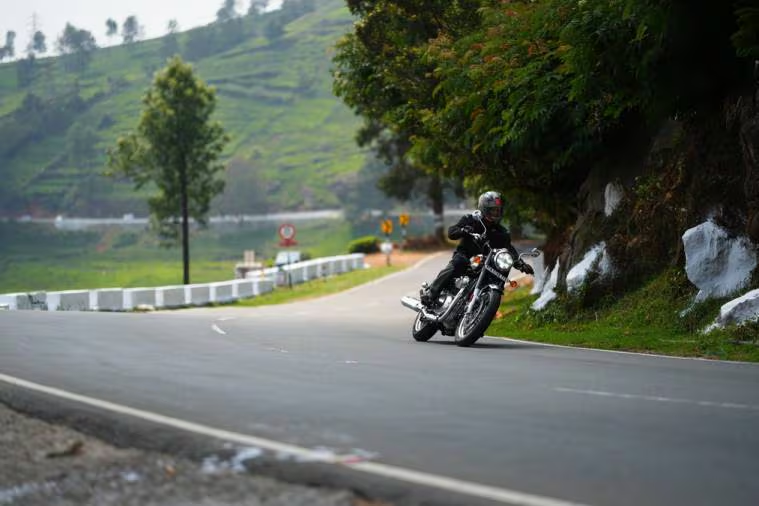
Design
“If it ain’t broke, don’t fix it” is Royal Enfield’s design philosophy for the new Classic 650. The familiar 647.9cc inline twin-cylinder engine is housed in the steel tubular spine frame chassis. As a result, you will immediately notice that the bike has two peashooter exhausts on either side, as opposed to the Classic 350’s single unit. Removable pillion seats, USB-Type C charging ports, the iconic hooded headlamp assembly, and all-LED lighting components are a few notable features. The road presence of the classic 650s is quite impressive. It appears sophisticated without much effort.
Even though the motif and general design are very similar to the Classic 350, it nevertheless has a striking appearance.Bruntingthorpe Blue and Vellam Red are the two paint options available for the base version. Additionally, the mid-variant completed in teal would cost you Rs 3.41 lakh. The premium Black Chrome model would set you back Rs 3.50 lakh. The Vellam Red features Royal Enfield printed in a funky typeface on the teardrop tank, which is unique to the aforementioned variety, while the Teal paintjob completes the subframe in body color, which looks very good. The paint scheme choices are the only distinction between all the variations.
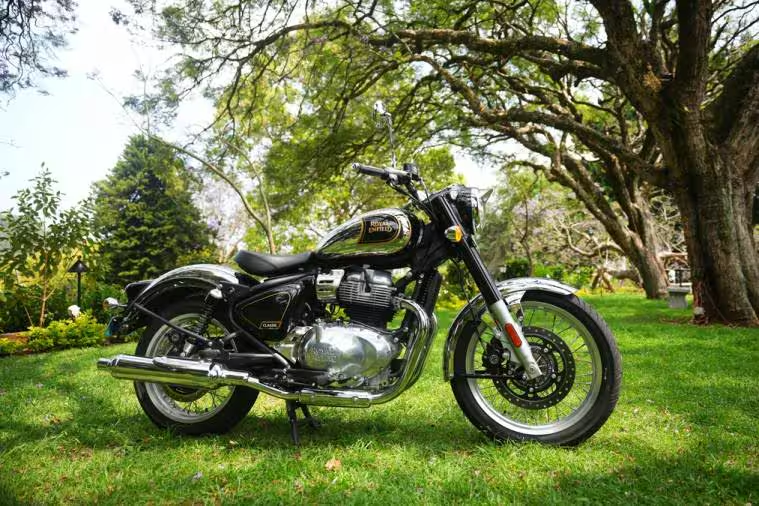
Dimensions and cycle parts
The dimensions of the Royal Enfield Classic 650 are 2,318 mm in length, 892 mm in width, 1,137 mm in height, and 1,475 mm in wheelbase. Additionally, it weighs 243 kg, making it the heaviest Royal Enfield. The Classic 650’s suspension system consists of a dual-shock arrangement at the back with 90 mm travel and a 43mm telescopic unit from Showa up front with 120 mm travel. a configuration akin to the Shotgun 650. However, it has been adjusted differently; we’ll discuss it later. Next, dual-channel ABS and a single 320mm rotor up front and a single 300mm rotor at the back control the braking functions. This configuration is comparable to that of the Shotgun 650 and Super Meteor 650.
The bike has an 18-inch wheel in the back and a 19-inch wheel up front. These spoke wheels enhance the bike’s vintage appearance, but the drawback is that they have tube tires, which is a huge letdown in the modern era. They are attempting to bring tubeless spoke wheels for the Classic 650, although a specific date has not been determined, according to a conversation with the executives. The teardrop tank has a 154mm ground clearance and a 14.8-liter gasoline capacity.
Performance
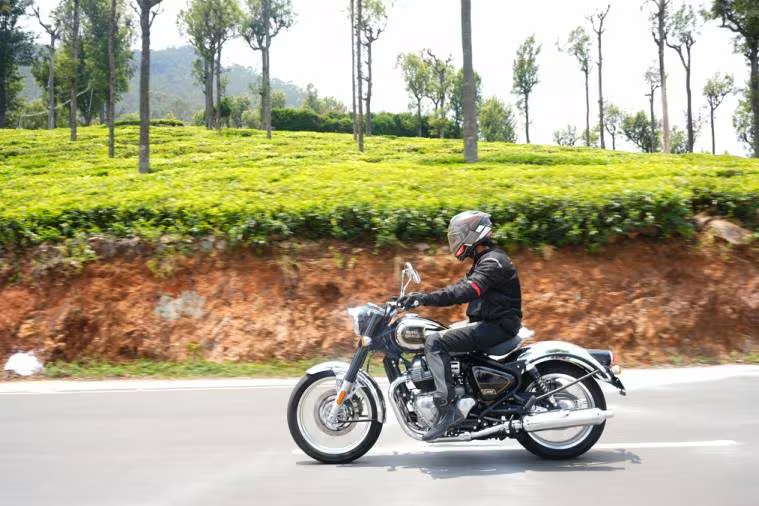
We are already familiar with the 647.95cc inline, twin-cylinder, four-stroke, SOHC engine found in the Royal Enfield Classic 650. It is coupled to a six-speed gearbox. The engine produces the same 47 PS and 52.3 Nm as the Super Meteor 650, Shotgun 650, and Bear 650. It is a sophisticated engine that produces a ton of torque at 5,650 rpm. It is also smooth and tractable. Additionally, there are no twitches or false neutrals in the gearbox’s smooth operation. It creates a lovely hum while idling at about 1200 rpm, which enhances the bike’s personality.
The engine will give you power in a sprightly manner if you flick the throttle; it is not lightning fast, but it does the job when fast overtakes are required. The engine can effortlessly cruise between 100 and 120 kmph. However, the seat vibrates initially when you push the engine beyond its comfort zone, which should be problematic for lengthy rides. The seat vibrations are noticeable and only get stronger when you reach higher revs, however the vibrations on the footpegs and handlebars are insignificant. The engine does not stall on you right off the line or even while you are riding; even when you are in overdrive, it pulls away smoothly. There are no issues with the engine.
Ride and handling
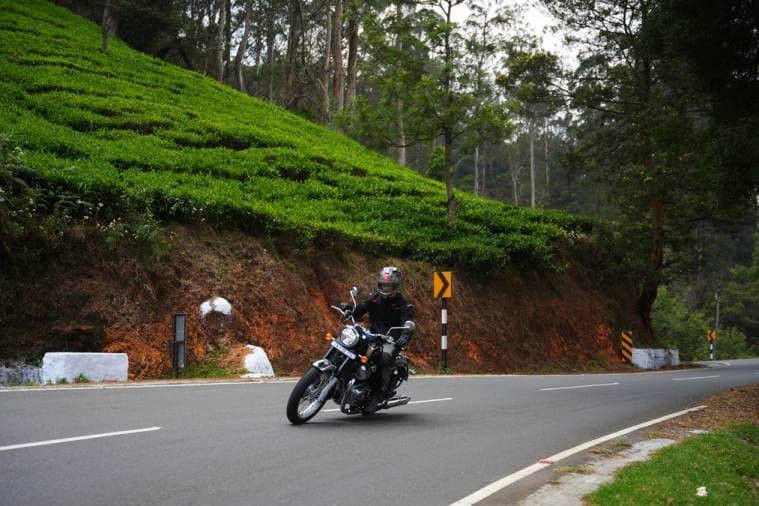
When you try to place the heaviest Royal Enfield on a center stand or move it around without the engine running, it does show how heavy it is. However, once the bike is rolling, the 243 kg kerb weight disappears; even at slow speeds, you don’t need to push it. To shift directions, a small prod will be sufficient. When moving, it is surprisingly agile.
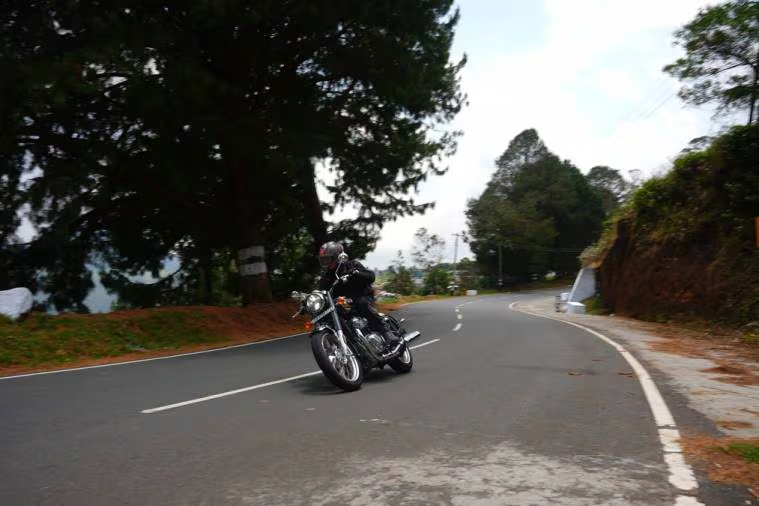
The suspension system is comparable to that of the Shotgun, and although it is somewhat stiffer, the ride is still comfortable. Although the rear suspension is a little firm, it does not make the ride bone-jarring. In contrast, the front suspension is slightly more forgiving. The overall quality of the ride is as fantastic as it gets. Although it is not a corner carver, it maintains the line flawlessly even at turns, giving the rider the confidence to lean farther. The footpegs scrape as you do this, and if you weigh more than 85 kg, the 154mm ground clearance may be an issue. The bike did not scrape its belly as I was riding over speed breakers because I am just 72 kg, but I believe a heavier rider will discover otherwise.
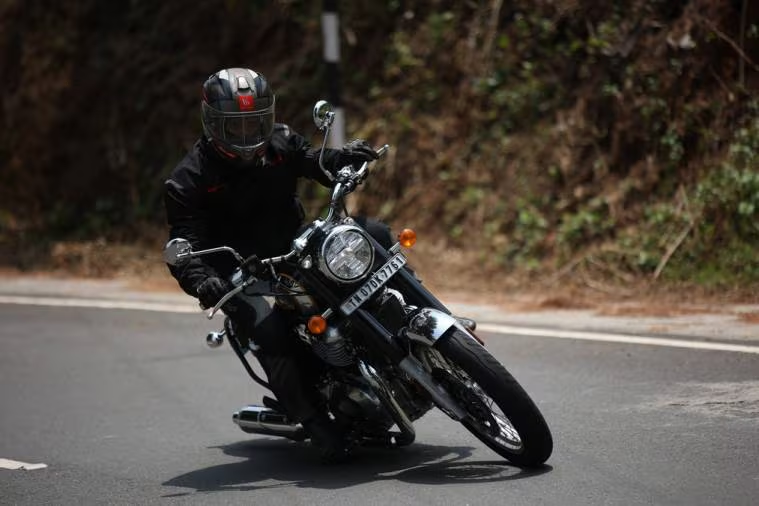
Going forward, the brakes could be enhanced. The rear brake bite is a tad too severe, and the front lever has no feedback. The back wheel receives an almost instantaneous ABS intervention. You can feel the ABS activating nearly immediately when you apply the rear brake. Every time I needed to use the horn while riding, I had to change my hand position because even the horn switch is slightly out of range.
Verdict
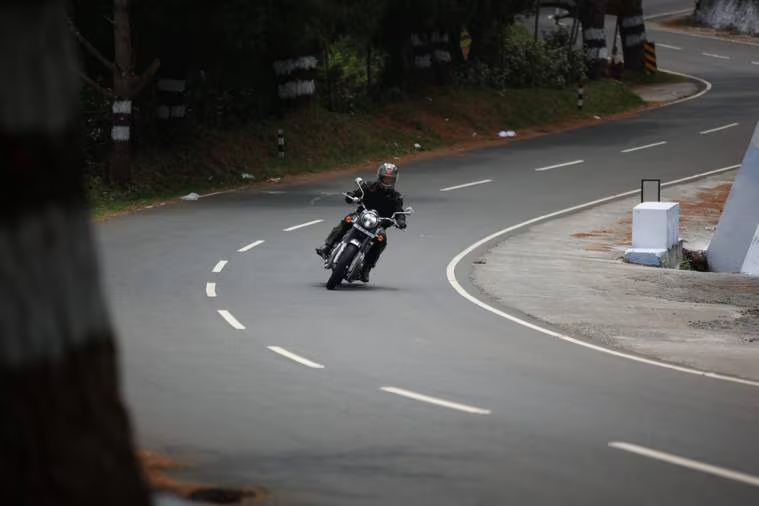
The 650cc engine gives the Royal Enfield Classic 650, a brand with a devoted fan base, additional power and performance, which is, in my opinion, a job well done. The RE Classic 650 makes a strong case for itself as a cruiser if I ignore small annoyances like the absence of feedback on the front brake lever, the immediate ABS intervention on the rear brake, and seat vibrations at high revs. The lack of tubeless spoke wheels is the sole drawback; although the company is working to find a way to include them with the bike, a specific timeframe has not yet been established.